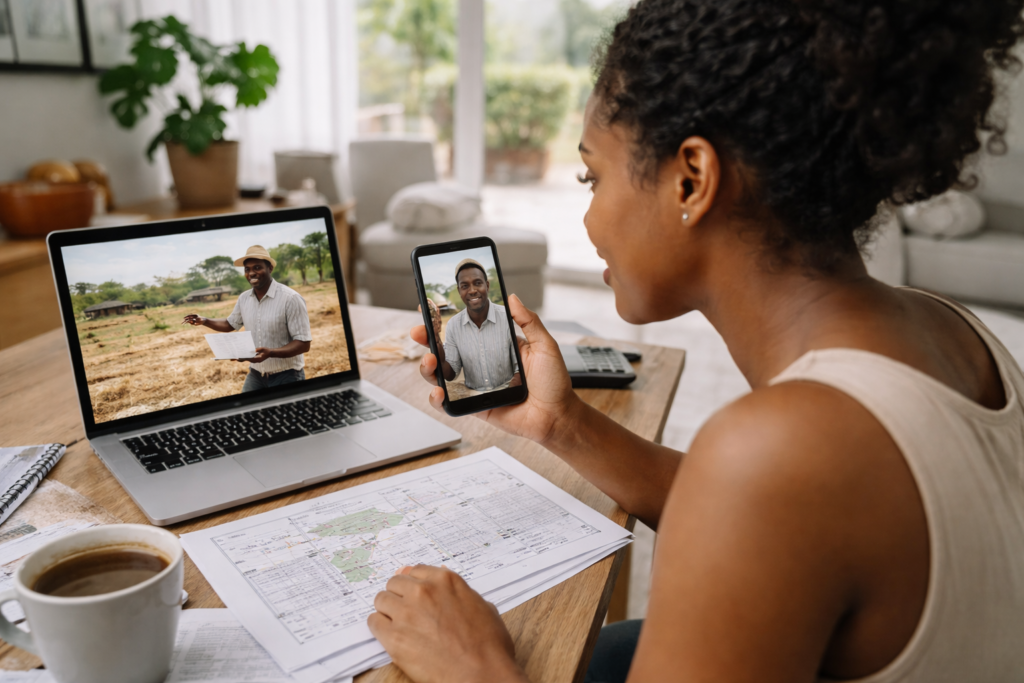
Buying land in Africa from abroad is increasingly common. Many diaspora buyers and overseas investors explore land opportunities without being physically present in the country where the property is located.
The question is not simply whether it is safe, but whether it is approached in a structured and informed manner.
Distance does not automatically create risk. However, it can increase reliance on intermediaries, limit physical verification, and introduce timing pressure. Understanding how remote buying changes risk exposure is essential before making financial commitments.
Key Considerations When Buying Land From Abroad
If you are considering buying land in Africa from overseas, you should evaluate:
- Who truly owns the land
- How documentation functions in that region
- Whether representatives have proper authority
- Whether boundaries are verified
- Whether payment timing aligns with verification
Each of these areas becomes more important when the buyer is not physically present.
1. Understanding Ownership From a Distance
Ownership systems in many African countries may involve:
- Individual title holders
- Extended family ownership
- Customary authorities
- Historical land allocations
When buying remotely, buyers may rely heavily on what they are told about ownership.
It is important to understand how authority is structured before proceeding. A representative may not be the sole owner, and broader consent may be required.
For deeper insight, see:
Ownership Structures Across African Land Systems
2. Evaluating Representatives and Intermediaries
Remote transactions often depend on agents, relatives, or local facilitators.
These individuals may:
- Introduce the land
- Coordinate meetings
- Relay information
- Assist with documentation
However, facilitation does not automatically equal authority.
Buyers should clarify:
- Who the representative speaks for
- Whether they have decision-making authority
- How information is independently verified
Learn more in:
How to Evaluate Land Representatives and Agents
3. Reviewing Documentation Carefully
From abroad, buyers may receive scanned copies of documents or summaries of land records.
Documentation can provide important information — but it should not be interpreted without context.
Buyers should consider:
- Who authorised the document
- Whether registration reflects full consent
- Whether statutory records align with customary systems
For further explanation, read:
Documentation Realities in African Land Transactions
4. Verifying Boundaries Without Physical Presence
Boundary verification becomes more complex when buyers cannot visit the land personally.
Survey plans may describe dimensions and coordinates, but buyers should also consider:
- Whether neighbouring land users recognise the same boundaries
- Whether survey documents are current
- Whether trusted professionals can conduct site visits
Boundary clarity remains important even when buying remotely.
See:
Understanding Survey Plans and Boundary Verification
5. Managing Payment Timing From Abroad
Payment timing is especially critical in remote transactions.
Distance can create urgency due to:
- Travel constraints
- Communication delays
- Fear of losing opportunity
Buyers should avoid making financial commitments before structured verification is complete.
Once funds are transferred internationally, reversing transactions may become more difficult.
For more details, read:
Payment Timing Risk in Land Transactions
Is It Riskier to Buy Land From Abroad?
Buying land from abroad is not inherently unsafe. However, remote transactions require more deliberate structure.
Risk often arises from:
- Over-reliance on a single source of information
- Limited verification
- Rushed payment decisions
- Misunderstanding ownership authority
A systematic evaluation process reduces uncertainty.
Applying a Structured Approach
Remote buyers benefit from following a connected framework rather than reviewing each factor separately.
A structured learning path that integrates:
- Ownership understanding
- Documentation interpretation
- Representation evaluation
- Boundary verification
- Payment timing
is outlined in:
The Structured Safe Land Buying Framework
Final Thoughts
Is it safe to buy land in Africa from abroad? It can be — when approached methodically.
Distance does not eliminate opportunity. However, it increases the importance of structured evaluation and patient decision-making.
Remote buyers who:
- Clarify ownership
- Evaluate representatives
- Review documentation carefully
- Verify boundaries
- Align payment with verification
are better positioned to make informed decisions.
Frequently Asked Questions
What should I check before buying land in Africa?
Before buying land in Africa, confirm ownership rights, review land documents carefully, ensure clear family or community consent, verify boundaries using survey plans, and avoid making payment until verification is complete.
Is land ownership in Africa always registered?
Not always. In many African contexts, statutory registration may coexist with customary or family ownership systems. Buyers should understand how the two systems interact.
Can I rely only on land documents?
Land documents are important, but they should be reviewed in context. Documentation may record transactions without confirming full consent or the authority structures.
Is it safe to buy land in Africa from abroad?
It can be safe when approached methodically. Remote buyers should carefully evaluate ownership, representatives, documentation, boundaries, and payment timing before committing funds.